LED lighting products require stable electrical performance, efficient heat transfer, reliable soldering, and long service life. For many lighting manufacturers, the PCB is not only a circuit carrier; it directly affects LED brightness, heat dissipation, assembly yield, product lifetime, and after-sales reliability. If the board cannot transfer heat efficiently, the LED may experience brightness decay, color shift, solder joint fatigue, or early failure.
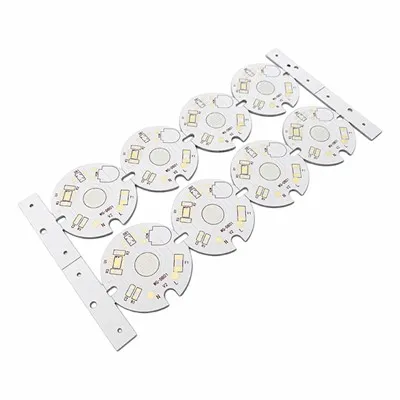
Our Aluminum LED PCB solutions are designed for LED bulbs, panel lights, downlights, street lights, high bay lights, automotive lighting, backlight modules, LED strips, and high-power lighting products. Compared with standard FR4 boards, aluminum-based boards provide better thermal performance and mechanical support, making them suitable for lighting applications that generate continuous heat during operation.
Customers usually care about several practical issues before placing an order: Can the board reduce LED temperature? Is the dielectric layer safe and reliable? What copper thickness should be used? Will the white solder mask remain clean and consistent? Can the board support stable SMT assembly? Can the sample quality be repeated in mass production? Our manufacturing support focuses on these real concerns, helping customers balance heat dissipation, electrical safety, solderability, brightness consistency, and cost.
Heat Dissipation
Heat dissipation is the most important reason many LED products use an aluminum substrate. LEDs generate heat during operation, and excessive heat can reduce luminous efficiency and shorten product life. If heat remains around the LED chips or solder joints, customers may face light decay, unstable color temperature, solder cracking, or product returns.
An aluminum-based circuit board helps transfer heat from the LED soldering area through the dielectric layer to the aluminum base. This creates a more effective thermal path than many standard circuit boards. For high-power lighting products, street lights, automotive lamps, and long-hour lighting applications, thermal performance is a key factor in product reliability.
We help customers review LED power, working current, board size, copper thickness, and installation structure before production. A suitable thermal design can reduce overheating risks and improve long-term lighting stability.
Thermal Conductivity
Thermal conductivity determines how efficiently heat can move from the LED area to the aluminum base. Customers often ask about the thermal conductivity value, dielectric thickness, and whether the material is suitable for their lighting power level. The dielectric layer is especially important because it must provide both heat transfer and electrical insulation.
A higher thermal conductivity material may be required for high-power LED modules, street lighting, automotive lighting, or compact lamps with limited cooling space. For standard indoor lighting, a balanced material option may be more cost-effective. The right choice depends on actual heat generation, product structure, operating environment, and budget.
|
Structure / Material |
Main Function |
Customer Benefit |
|
Copper Circuit Layer |
Conducts current and forms LED pads |
Supports stable current transmission |
|
Thermal Dielectric Layer |
Transfers heat and provides insulation |
Improves thermal performance and electrical safety |
|
Aluminum Base |
Spreads heat and provides mechanical support |
Reduces temperature rise and improves durability |
|
High Thermal Conductivity Material |
Enhances heat transfer |
Suitable for high-power lighting |
|
Thicker Copper Option |
Improves current capacity |
Helps reduce voltage drop and local heating |
Current Stability
Current stability directly affects LED brightness, heat generation, and product consistency. If the copper thickness is insufficient or the trace width is not suitable, the board may generate extra heat, cause voltage drop, or create uneven brightness across the lighting product.
For LED strips, panel lights, high bay lights, and large LED modules, stable current transmission is very important. Long circuits or high-density LED layouts may require wider traces, thicker copper, or optimized routing to reduce power loss. When designing an Al PCB for LED, customers should consider working current, LED spacing, product length, and thermal structure together.
We can recommend suitable copper thickness and circuit design based on customer requirements, helping reduce brightness instability and long-term electrical stress.
Brightness Consistency
Brightness consistency is a major concern for lighting brands. Uneven brightness may be caused by voltage drop, unstable current distribution, poor solder joints, inconsistent copper thickness, or local overheating. For panel lights, backlight modules, RGB lighting, and decorative lighting products, visual consistency directly affects product quality.
A stable board structure helps support uniform lighting output. Copper thickness control, accurate circuit production, clean soldering surfaces, and reliable thermal performance all contribute to consistent brightness. In mass production, batch consistency is also important because customers need every order to perform the same as the approved sample.
By controlling materials, surface finish, solder mask quality, and electrical testing, we help customers reduce visible differences and improve finished lighting reliability.
Insulation Safety
Insulation safety is critical because an aluminum-based board includes conductive copper circuits and a metal base. The dielectric layer must provide reliable electrical insulation while still transferring heat efficiently. Customers are often concerned about breakdown voltage, insulation resistance, creepage distance, and safe spacing between conductive areas.
For high-voltage lighting products, industrial lamps, street lights, and export lighting projects, insulation performance should be reviewed before production. A material with good dielectric strength can help reduce electrical risk and improve product safety. Board design should also consider spacing, hole position, edge distance, and final assembly environment.
We help customers select suitable dielectric materials and manufacturing specifications according to product safety needs.
White Solder Mask
White solder mask is commonly used in LED lighting because it improves appearance and helps reflect light. For visible lighting boards, panel lights, backlight products, and LED modules, the surface color and finish quality can affect the final product look.
Customers often worry about yellowing, contamination, uneven surface color, or solder mask opening accuracy. Poor solder mask control may also affect LED placement and soldering quality. We focus on solder mask adhesion, opening precision, surface cleanliness, and appearance consistency to support both function and visual quality.
A good white surface is not only cosmetic. It helps customers improve product presentation and maintain consistent lighting appearance.
Solderability
Solderability affects SMT yield and long-term reliability. LED components, resistors, capacitors, and connectors must be soldered firmly and consistently. Poor solderability can lead to weak joints, poor wetting, LED shifting, rework, or early failure during use.
Surface finish selection plays an important role. Lead-free HASL is often used for cost-effective standard lighting products. ENIG provides a flatter surface and is suitable for fine-pitch or higher-reliability designs. OSP may be used for cost-sensitive mass production with controlled storage and assembly conditions.
For a reliable LED Lighting Aluminum PCB, pad design, surface finish, solder mask opening, cleanliness, and packaging protection should all be controlled carefully. This helps reduce assembly defects and improve production efficiency.
Material Selection
Material selection should match the LED power, heat requirement, current load, assembly method, and product budget. Not every project needs the highest-cost material, but under-specifying the board can cause overheating, unstable brightness, or safety risks.
|
Option |
Suitable Use |
Key Advantage |
|
Standard Aluminum Base |
Indoor lamps, bulbs, panel lights |
Good balance of cost and heat transfer |
|
High Thermal Conductivity Base |
High-power modules, street lights, vehicle lighting |
Better heat dissipation |
|
1oz Copper |
Standard LED lighting |
Cost-effective current support |
|
2oz or Higher Copper |
Higher-current lighting products |
Better current capacity and reduced heating |
|
Lead-Free HASL |
General LED products |
Practical and cost-effective |
|
ENIG |
Fine-pitch or premium products |
Flat surface and strong solderability |
|
White Solder Mask |
Visible lighting boards |
Better appearance and light reflection |
The best option should be selected according to actual working conditions. We can help customers avoid both over-design and under-design.
Prototype to Mass Production
LED lighting projects usually start with prototypes for brightness testing, thermal evaluation, assembly verification, and structure confirmation. After the sample is approved, customers often move to small-batch testing, pilot production, and mass production.
During the prototype stage, customers need fast feedback and practical material suggestions. During mass production, they care more about batch consistency, delivery stability, cost control, and quality inspection. We support the full process by reviewing Gerber files, copper thickness, board thickness, thermal conductivity requirements, solder mask color, surface finish, LED power, working current, and final application details.
Clear specifications from the beginning help reduce sample revisions and improve mass production stability.
Cost Optimization
Cost optimization is important in LED lighting because many products are produced in large quantities and face strong market competition. However, choosing the lowest-cost board without considering heat dissipation, insulation, or solderability may lead to higher failure costs later.
Cost can be optimized by selecting the right thermal conductivity level, copper thickness, board thickness, surface finish, and solder mask type. Panelization and production volume also affect unit price. For standard lighting products, a balanced material structure may be enough. For high-power or long-life applications, better thermal performance may reduce total cost by lowering failure and maintenance risks.
Our goal is to help customers achieve reliable lighting performance at a reasonable production cost.
FAQ
Q1: Why is aluminum substrate used for LED lighting boards?
It helps transfer heat away from LED components, improving thermal management, brightness stability, and long-term reliability.
Q2: What affects heat dissipation performance?
Copper thickness, dielectric thermal conductivity, dielectric thickness, aluminum base thickness, LED pad design, and the final lamp housing all affect heat transfer.
Q3: Is white solder mask necessary?
It is not always required, but it is common for LED lighting because it improves appearance and light reflection, especially for visible boards and panel lighting.
Q4: Which surface finish is suitable?
Lead-free HASL is practical for standard lighting products, ENIG is suitable for fine-pitch or high-reliability designs, and OSP can be used for cost-sensitive projects with controlled assembly.
Q5: Can aluminum-based boards support high-power LED products?
Yes, but material thermal conductivity, copper thickness, insulation performance, board structure, and heat sink design should be reviewed carefully.
Hot Tags: rigid-flex PCB prototype, China rigid-flex PCB prototype manufacturers, suppliers, factory