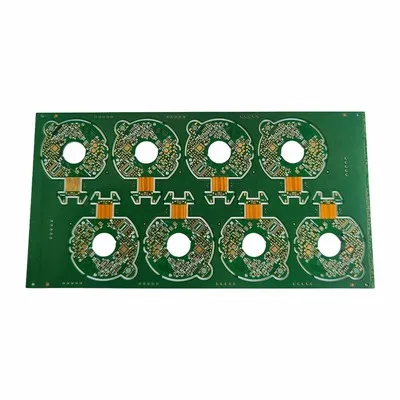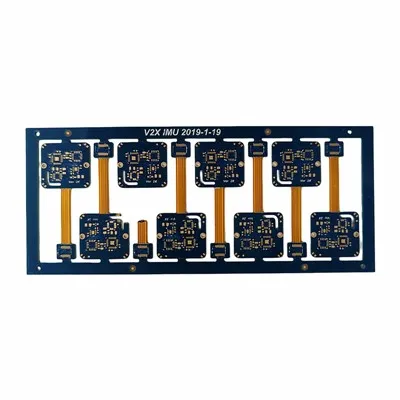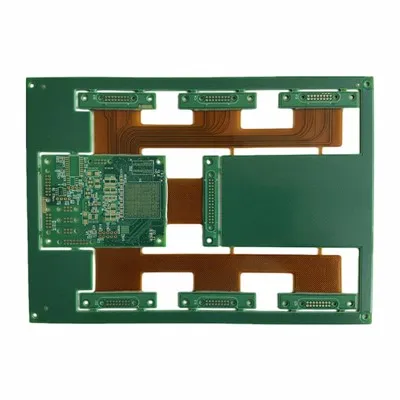

Product Details
High Density Rigid-Flex PCB is a hybrid circuit board technology that combines rigid PCB sections and flexible circuit sections within a single integrated structure while incorporating high-density interconnection features such as microvias, fine lines and multilayer routing. This technology is widely used in aerospace equipment, medical electronics, industrial automation, defense systems, communication devices and advanced consumer electronics where compact design, high reliability and complex signal routing are required.

Product Structure and Design Characteristics
A High Density Rigid-Flex PCB combines the advantages of both rigid and flexible circuits.
The rigid sections provide mechanical support for components such as processors, memory devices, connectors and power modules.
The flexible sections serve as integrated interconnections between rigid areas, allowing the board to bend, fold and fit into compact enclosures.
High-density design features commonly include:
- Microvias
- Blind vias
- Buried vias
- Fine trace routing
- High layer count structures
- Sequential lamination
These technologies create additional routing channels and allow more electronic functions to be integrated within limited board dimensions.
As electronic assemblies become increasingly complex, the ability to combine mechanical flexibility and high-density routing becomes a significant design advantage.

Manufacturing Capabilities Required for High Density Rigid-Flex PCB
Producing a high-density rigid-flex board requires substantially more manufacturing expertise than standard rigid PCB fabrication.
Several critical processes directly influence product quality and production yield.
Precision Lamination
Multiple rigid and flexible materials must be accurately laminated together while maintaining dimensional stability.
Poor lamination control may lead to alignment issues, delamination or reliability concerns.
01
Laser Microvia Processing
Microvias are commonly used to increase routing density.
Laser drilling systems must achieve precise positioning and consistent hole quality to ensure reliable electrical performance.
02
Fine Line Imaging
High-density circuits require narrow trace widths and tight spacing.
Advanced imaging equipment helps maintain conductor accuracy during production.
03
Registration Control
Rigid and flexible sections must remain properly aligned throughout the manufacturing process.
As layer counts increase, maintaining registration becomes increasingly challenging.
04
Copper Plating Consistency
Reliable interconnections depend on uniform copper deposition throughout the board structure.
Strong process control helps improve long-term reliability and production yield.
05
◆ Manufacturers with dedicated rigid-flex production experience generally achieve more stable results than suppliers that primarily focus on conventional PCB fabrication.
Common Design Challenges
Although High Density Rigid-Flex PCB technology offers significant benefits, several design considerations require careful attention.
Space Allocation
Rigid and flexible regions must be planned together during the design stage.
Improper space allocation can increase assembly difficulty and reduce reliability.
Bend Area Protection
Flexible areas should be designed to minimize mechanical stress during operation.
Critical traces are often routed away from bend zones whenever possible.
Layer Stack-Up Optimization
The stack-up structure directly influences flexibility, routing capability and manufacturability.
Component Distribution
High-density components should be placed strategically to balance performance and assembly requirements.
Thermal Considerations
Compact designs often increase power density, making thermal management more important.
Early collaboration between designers and manufacturers frequently helps reduce these risks before fabrication begins.
Typical Applications
High Density Rigid-Flex PCB technology is commonly selected when traditional board architectures cannot satisfy both space and performance requirements.
Representative applications include:
√ Medical Devices
Portable diagnostic systems and advanced imaging equipment often require compact electronic packaging.
√ Aerospace Systems
Weight reduction and reliability remain critical priorities in aerospace applications.
√ Military Electronics
Mission-critical systems frequently utilize rigid-flex technology to improve durability and reduce connector usage.
√ Industrial Control Equipment
Automation systems benefit from reduced wiring complexity and improved space utilization.
√ Communication Infrastructure
Advanced communication devices often require dense signal routing within compact mechanical designs.
These applications typically demand both high performance and long-term reliability.

Quality Control and Reliability Verification
Because High Density Rigid-Flex PCB assemblies are frequently used in demanding environments, quality verification plays a major role throughout production.
Typical inspection methods include:
- Automated Optical Inspection
- X-ray Inspection
- Electrical Testing
- Microsection Analysis
- Dimensional Measurement
- Reliability Evaluation
- Manufacturers often perform additional verification for projects with strict performance requirements.
- Testing programs may include:
- Thermal cycling
- Flex endurance testing
- Humidity exposure
- Mechanical stress evaluation
- Solderability assessment
These validation procedures help ensure consistent performance throughout the product lifecycle.
Cost Factors Influencing Procurement Decisions
High Density Rigid-Flex PCB projects generally involve higher manufacturing costs than conventional PCB assemblies.
Several factors contribute to pricing:
|
Cost Driver |
Impact |
|
Layer Count |
High |
|
Microvia Quantity |
High |
|
Flexible Material Usage |
Medium |
|
Sequential Lamination Cycles |
High |
|
Fine Line Requirements |
High |
|
Inspection Complexity |
Medium to High |
Although fabrication costs may increase, many companies achieve system-level savings through:
- Reduced connectors
- Lower assembly labor
- Smaller enclosures
- Simplified wiring
- Improved reliability
Evaluating total product cost rather than board cost alone often provides a more accurate picture of project economics.
Supplier Selection Considerations
Selecting a capable supplier is one of the most important factors affecting project success.
Key evaluation criteria include:
√ Proven Rigid-Flex Experience
Past production experience often indicates process maturity.
√ High-Density Manufacturing Capability
Suppliers should demonstrate successful production of similar structures.
√ Engineering Support
Design reviews can identify manufacturability concerns before production.
√ Quality Management Systems
Robust quality procedures help maintain consistency.
√ Prototype and Volume Production Support
Suppliers should be capable of supporting products throughout their lifecycle.
A strong manufacturing partner can significantly reduce development risks and improve long-term production stability.
Future Development Trends
Several technology trends continue driving demand for High Density Rigid-Flex PCB solutions:
- Artificial intelligence hardware
- Autonomous systems
- Portable medical devices
- Advanced communication networks
- Industrial IoT equipment
- Aerospace electronics
As electronic products require greater functionality within smaller form factors, high-density rigid-flex technology will remain an important platform for future product development.
Manufacturers that invest in advanced process control, precision manufacturing equipment and engineering expertise will be best positioned to support these evolving requirements.
FAQ
Q: What is a High Density Rigid-Flex PCB?
A: A High Density Rigid-Flex PCB is a circuit board that combines rigid and flexible sections while incorporating high-density interconnection technologies such as microvias, fine traces and multilayer routing structures.
Q: What are the advantages of High Density Rigid-Flex PCB technology?
A: The technology helps reduce product size, eliminate connectors, improve reliability and support complex electronic designs.
Q: Which industries commonly use High Density Rigid-Flex PCBs?
A: Medical, aerospace, defense, industrial automation and communication industries frequently utilize this technology.
Q: Why are High Density Rigid-Flex PCBs more expensive?
A: Additional manufacturing processes, advanced materials and tighter process control requirements increase production complexity and cost.
Hot Tags: high density rigid-flex pcb, China high density rigid-flex pcb manufacturers, suppliers, factory, multilayer flex pcb, multilayer flexible pcb fabrication, pcb flex board