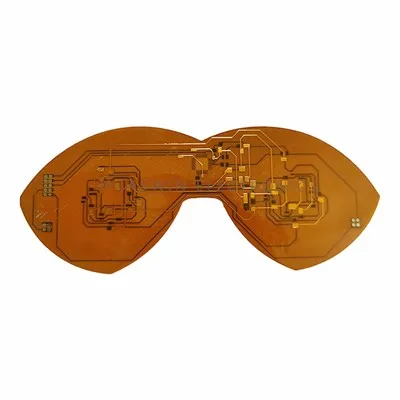

Product Details
Multilayer Flex PCB, or multilayer flexible printed circuit board, consists of multiple layers of flexible dielectric films bonded together with conductive copper traces, combining high-density circuit routing with outstanding bending and folding capabilities. Different from rigid multilayer PCBs, multilayer flex PCBs can withstand repeated flexing, twisting and dynamic movement while maintaining stable electrical performance. They support complex 3D assembly, save internal product space and simplify mechanical structure design. Typical applications include wearable devices, medical equipment, automotive internal wiring, camera modules and industrial flexible connection systems. When selecting multilayer flex PCBs, engineers and buyers should consider flexing cycles, material grade, thickness constraints and cost trade-offs to match real-world mechanical and electrical requirements.

Advantages of Multilayer Flex PCBs Over Standard Flex Circuits
Many electronic projects begin with a simple flexible circuit design. As product functionality increases, however, routing space quickly becomes limited.
Several common design challenges often lead to the adoption of multilayer flex technology:
- Higher signal counts
- Compact product dimensions
- Reduced connector requirements
- Limited installation space
- Increased circuit complexity
- Weight reduction targets
Instead of adding separate rigid boards and wire harnesses, engineers can integrate multiple functions into a single flexible assembly.
This approach can reduce assembly time, simplify product architecture and improve overall system reliability.

Typical Applications Requiring Multilayer Flex PCB
Not every flexible circuit project requires multiple layers. In many applications, a double-layer flex PCB remains sufficient.
Multilayer structures are commonly used when performance and space constraints become more demanding.
Medical Equipment
Portable diagnostic devices, imaging systems and patient monitoring equipment often require compact and highly reliable interconnections.
01
Aerospace Electronics
Aircraft and satellite systems frequently prioritize weight reduction while maintaining high reliability standards.
02
Automotive Electronics
Advanced driver assistance systems, battery management units and sensor modules often utilize multilayer flexible circuits.
03
Industrial Automation
Robotics and automation equipment benefit from compact circuit integration and improved durability.
04
Consumer Electronics
High-end cameras, wearable devices and portable communication products frequently use multilayer flex technology to maximize functionality within limited space.
05
These applications typically require a balance between miniaturization, reliability and long-term performance.
Manufacturing Challenges That Affect Cost and Quality
One reason Multilayer Flex PCBs are more expensive than standard flexible circuits is the increased manufacturing complexity.
Several processes directly influence production difficulty.
Layer Alignment
Multiple flexible layers must be accurately registered during lamination. Misalignment can affect electrical performance and yield.
Flexible Material Handling
Flexible substrates are more difficult to process than rigid materials because they are prone to stretching and deformation.
Lamination Control
Temperature, pressure and material compatibility must be carefully controlled to ensure structural integrity.
Hole Formation and Plating
Reliable interconnections between layers are critical for long-term performance.
Dimensional Stability
As layer count increases, maintaining consistent dimensions becomes more challenging.
Manufacturers with extensive multilayer flex experience are generally better equipped to control these variables and maintain production consistency.
Common Layer Configurations
The optimal layer count depends on the complexity of the design rather than a predetermined standard.
Typical configurations include:
|
Configuration |
Common Applications |
|
4 Layer Flex PCB |
Medical devices, industrial controls |
|
6 Layer Flex PCB |
Communication equipment |
|
8 Layer Flex PCB |
Aerospace and defense electronics |
|
10+ Layer Flex PCB |
Advanced high-density systems |
Higher layer counts provide additional routing flexibility but also increase manufacturing costs and lead times.
For many projects, the most cost-effective solution is the lowest layer count capable of meeting electrical and mechanical requirements.
Reliability Factors Buyers Should Evaluate
Reliability is often a greater concern than unit price when sourcing multilayer flexible circuits.
Several factors significantly affect product lifespan.
√ Dynamic Flexing Requirements
Some products experience continuous movement throughout their operating life.
√ Thermal Cycling
Repeated temperature changes can create stress within multilayer structures.
√ Mechanical Durability
Installation and operational conditions influence long-term performance.
√ Material Selection
Different substrate and adhesive systems offer varying levels of reliability.
√ Environmental Conditions
Humidity, vibration and exposure to contaminants may affect product durability.
Understanding these conditions during the design phase helps ensure that the final product meets performance expectations.

Cost‑Reduction Benefits of Multilayer Flex PCBs
Although multilayer flexible circuits generally have higher fabrication costs than standard rigid boards, they can often reduce total project costs.
Potential savings may come from:
- Fewer connectors
- Reduced wiring assemblies
- Smaller product enclosures
- Faster assembly processes
- Lower system weight
- Improved reliability
Many companies initially focus on PCB pricing alone and overlook these system-level benefits.
In complex electronic products, the overall cost reduction can outweigh the higher PCB manufacturing expense.
Supplier Evaluation Checklist
When sourcing Multilayer Flex PCBs, buyers should verify more than basic production capability.
Important evaluation criteria include:
- Maximum supported layer count
- Experience with flexible materials
- Reliability testing capability
- Process control systems
- Engineering support resources
- Prototype production experience
- Quality certification status
A supplier with proven multilayer flex expertise can often identify potential manufacturability issues before production begins, reducing project risk and development delays.
Market Trends Driving Demand
Several technology trends continue to increase demand for multilayer flexible circuits:
- Medical device miniaturization
- Electric vehicle growth
- Wearable electronics expansion
- Aerospace weight reduction initiatives
- Industrial automation upgrades
As products continue becoming smaller and more sophisticated, designers increasingly require flexible interconnection solutions that can support higher circuit density without increasing product size.
Multilayer Flex PCB technology provides a practical path toward achieving these goals while maintaining reliability and performance.
FAQ
What is a Multilayer Flex PCB?
A Multilayer Flex PCB is a flexible printed circuit board containing three or more conductive layers laminated together within a flexible structure.
Why use a multilayer flex design instead of a double-layer flex PCB?
Multilayer designs provide additional routing space, support higher circuit density and enable more compact product architectures.
Are Multilayer Flex PCBs more expensive?
Yes. Additional materials, lamination cycles and manufacturing complexity generally increase production costs.
What industries commonly use Multilayer Flex PCBs?
Medical, aerospace, automotive, industrial automation and advanced consumer electronics industries frequently use multilayer flex technology.
Hot Tags: multilayer flex pcb, China multilayer flex pcb manufacturers, suppliers, factory, flex pcb assembly, flexible pcb substrate, flexible printed circuit, flexible printed circuit board, flexible rigid pcb, rigid flex board